Sheet Metal Materials Explained: How to Choose Between Mild Steel, SS304, SS316, Aluminium 6061, GI and Copper
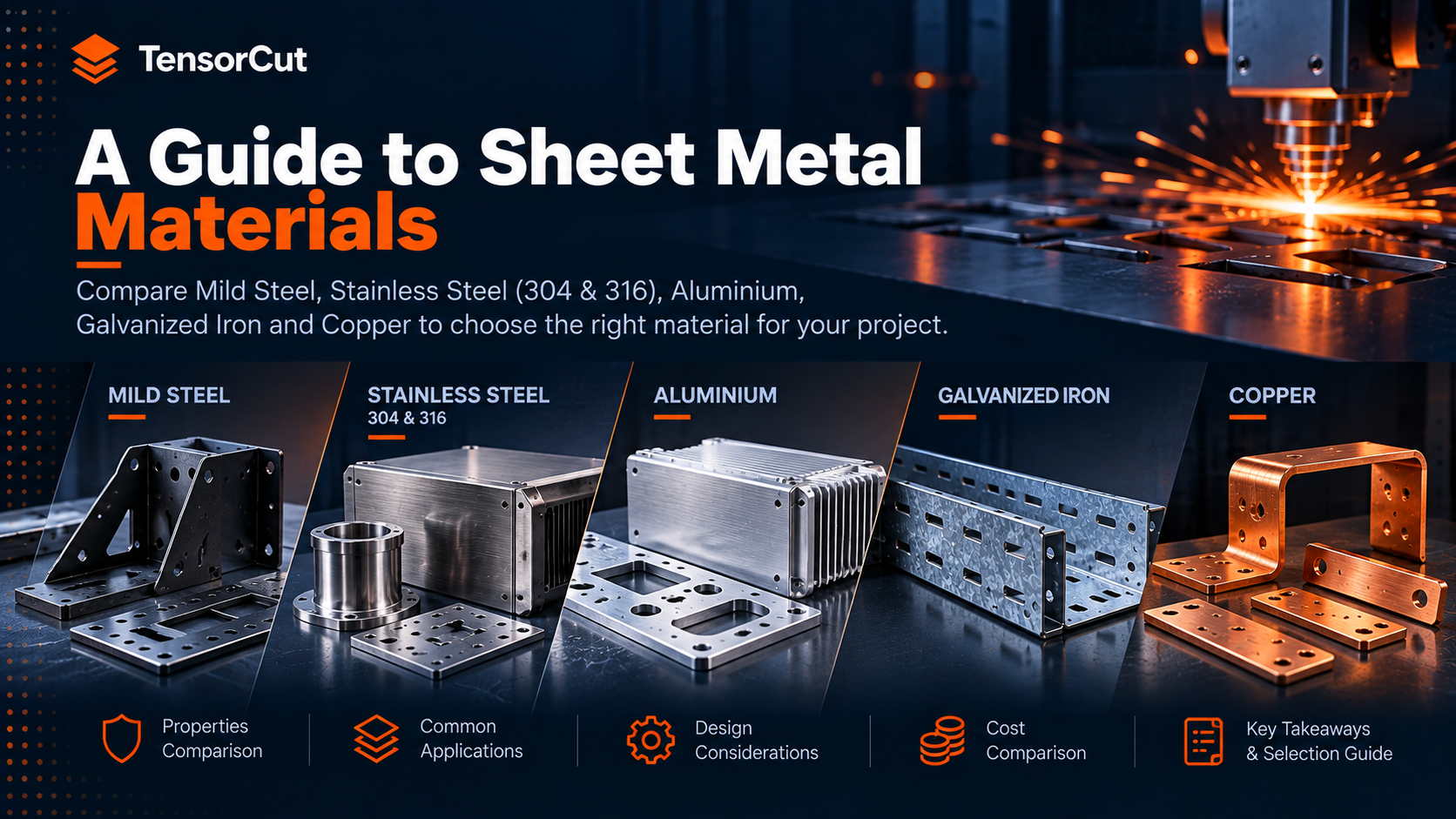
Choosing the right sheet metal material can determine a part's strength, weight, corrosion resistance, appearance, manufacturability and cost. This practical TensorCut guide explains when to use Mild Steel, Stainless Steel 304, Stainless Steel 316, Aluminium 6061, Galvanized Iron and Copper for real-world applications.
Sheet Metal Materials Explained: How to Choose the Right Material for Your Part
When designing a sheet metal component, one of the first questions is deceptively simple:
"Which material should I use?"
The answer affects almost everything that follows — the strength of the part, its weight, corrosion resistance, appearance, bendability, weldability, manufacturing process, service life and ultimately its cost.
A mounting bracket used inside a machine does not necessarily need stainless steel. A food-processing enclosure probably should not be made from untreated mild steel. A part exposed to coastal salt spray may need a different material from an identical part installed inside a factory.
This is why material selection should begin with the application, rather than simply choosing the material that is most familiar. At TensorCut, we support six commonly used sheet metal materials: Mild Steel, Stainless Steel 304, Stainless Steel 316, Aluminium 6061, Galvanized Iron and Copper.
This guide explains where each material makes sense and how to make the right choice quickly.
The Quick Answer: Which Material Should You Choose?
| If your part needs... | Consider |
|---|---|
| Low cost + good strength + general fabrication | Mild Steel |
| Corrosion resistance + hygiene + good appearance | Stainless Steel 304 |
| Resistance to salt, chlorides or aggressive environments | Stainless Steel 316 |
| Low weight + good strength-to-weight ratio | Aluminium 6061 |
| Economical outdoor corrosion protection | Galvanized Iron (GI) |
| Very high electrical or thermal conductivity | Copper |
These are starting points rather than universal rules. Actual choice should consider the environment, loads, manufacturing process, thickness and finish.
1. Mild Steel — The General-Purpose Workhorse

Mild steel is one of the most widely used materials in sheet metal fabrication because it offers strength, availability, weldability, formability and relatively low material cost.
Why choose it? Good mechanical performance without premium cost. Mild steel is easy to laser cut, bend, weld, drill, machine, paint and powder coat — making it the natural starting point for many industrial designs.
The limitation: Untreated mild steel does not have the corrosion resistance of stainless steel. If exposed to moisture, the surface can rust. Protect it with powder coating, painting, electroplating, hot-dip galvanizing or other coatings.
Choose mild steel when: Strength and cost are important, but extreme corrosion resistance is not. For example, an indoor electrical enclosure that will be powder coated.
2. Stainless Steel 304 — The Everyday Corrosion-Resistant Choice

Stainless Steel 304 is one of the most widely used stainless grades in sheet metal fabrication. It combines good corrosion resistance, formability, weldability, high strength, good appearance and low maintenance.
Why is 304 popular? The chromium content allows a passive oxide layer to form on the surface, providing corrosion resistance. You don't need paint or powder coating to protect the base metal. This is particularly valuable when the surface must remain clean, the part is frequently washed, or the appearance of the metal matters.
Common applications: Commercial kitchen equipment, food-processing equipment, restaurant equipment, pharmaceutical equipment, electrical enclosures, architectural panels, wash-down environments.
Choose SS304 when: You need good corrosion resistance, hygiene and a clean industrial appearance.
3. Stainless Steel 316 — When the Environment Gets Aggressive
SS316 looks similar to SS304, but becomes important when the environment contains chlorides, salt or more aggressive chemicals. SS316 contains molybdenum, which improves resistance to localized corrosion in chloride-containing environments.
SS304 vs SS316:
SS304 → general corrosion-resistant applications
SS316 → applications with chloride or aggressive chemical exposure
An electrical enclosure in a dry factory may not require SS316. The same enclosure near the coast may need the upgrade due to salt-laden air.
Choose SS316 when: The part will regularly encounter saltwater, chlorides or aggressive chemical environments. Marine equipment, coastal installations and pharmaceutical environments are typical applications.
4. Aluminium 6061 — When Weight Matters

Aluminium 6061 is fundamentally different from steel because its density is only around one-third that of steel. TensorCut lists Aluminium 6061 at approximately 2.70 g/cm³, compared with 7.85–7.98 g/cm³ for steel materials.
Why choose it? Its main attraction is its strength-to-weight ratio. Two brackets with identical dimensions — one steel, one aluminium — will have dramatically different weights. This is extremely valuable for parts mounted on moving assemblies, vehicles, robotic systems, aerospace applications, drones or EV systems.
Important note: 6061-T6 is strong but less ductile than sheet-forming alloys. If you need significant bending, review the specific alloy and temper carefully.
Choose Aluminium 6061 when: Weight matters and the mechanical requirements suit the alloy and temper.
5. Galvanized Iron — Practical Corrosion Protection at Lower Cost
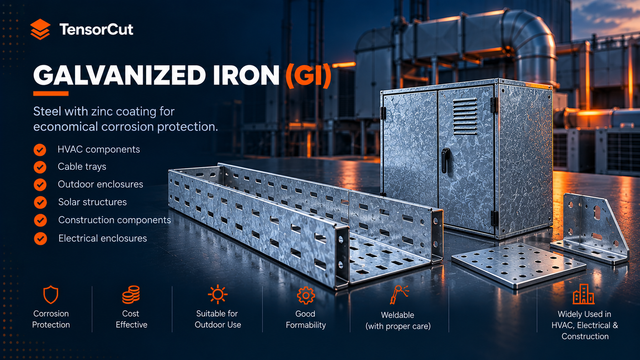
Galvanized Iron (GI) is essentially steel protected by a zinc coating. The zinc coating provides corrosion protection to the underlying steel while retaining steel-like structural characteristics.
GI vs Mild Steel:
Mild Steel → Steel + protective coating added separately if required
Galvanized Iron → Steel + zinc coating supplied as part of the material
An outdoor cable tray exposed to rain and humidity can eliminate the need for a separate painting operation with GI.
Typical applications: HVAC ductwork, cable trays, electrical enclosures, outdoor equipment, roofing accessories, solar structures, transformer components, switchgear enclosures.
Choose GI when: You need steel with built-in zinc-based corrosion protection, particularly for outdoor, HVAC and construction applications.
6. Copper — When Electrical and Thermal Conductivity Matter

Copper is different from the other materials in this guide. You generally do not select copper because it is the cheapest structural sheet metal. You select it because of its excellent electrical and thermal conductivity.
Why copper? A busbar must carry electrical current efficiently. Using mild steel simply because it is cheaper would fundamentally change the function. The same principle applies to thermal applications — if the purpose is to transfer heat, thermal conductivity becomes more important than structural strength.
Common applications: Busbars, electrical connectors, switchgear components, grounding plates, heat sinks, thermal plates, EMI/RFI shielding.
Disadvantages: Copper is heavy, relatively expensive, softer than steel, prone to cosmetic damage and more challenging to fabricate cleanly.
Choose Copper when: Electrical or thermal conductivity is a primary function of the component.
TensorCut Material Selection Cheat Sheet
Choose Mild Steel when you need an economical, strong, general-purpose material and can use a protective finish.
Choose SS304 when you need good corrosion resistance, hygiene and a clean industrial appearance.
Choose SS316 when the part will experience salt, chlorides or a more aggressive environment.
Choose Aluminium 6061 when reducing weight is important and the mechanical requirements suit the alloy and temper.
Choose GI when you need steel with built-in zinc-based corrosion protection, particularly for outdoor, HVAC and construction applications.
Choose Copper when electrical or thermal conductivity is a primary function of the component.
The Most Important Question: What Is the Part Actually Supposed to Do?
It is tempting to select material based on a simple hierarchy: Steel → Stainless → Aluminium → Copper. But that isn't how engineering material selection works.
Each material solves a different problem.
A machine bracket might prioritize strength + cost. A food-processing enclosure might prioritize hygiene + corrosion resistance. A drone bracket might prioritize low mass + adequate strength. A coastal enclosure might prioritize chloride resistance. A busbar might prioritize electrical conductivity.
The "best" material changes because the function of the part changes.
Ready to Design Your Part?
Material selection shouldn't require multiple phone calls, spreadsheets and back-and-forth emails.
With TensorCut, you can upload your CAD design, select the material and thickness, and get an instant manufacturing quote for precision sheet-metal fabrication.
Choose the material based on what the part needs to do. Then let the manufacturing process follow the design.
TensorCut — Precision sheet metal fabrication, on demand.
Upload your CAD file. Configure your material. Get your quote.